
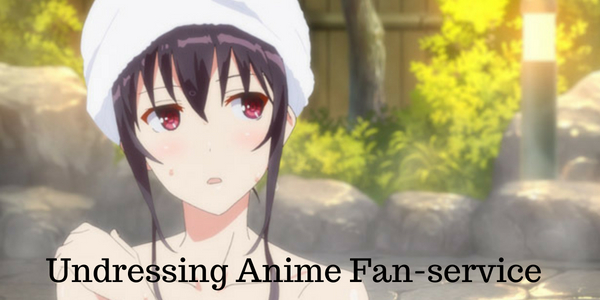
 I get it, some of you like fan-service, but fan-service has become a blight on anime as a whole. It’s fine when it appears in genres you fully expect to see it in: ecchi and hentai. Let it remain there. However, the mentality behind fan-service has leeched most categories of anime. Breast jokes have no place, nor are they funny, in an action anime like Bleach. They only hurt the storytelling in a series that already hurts for good pacing and plotting.
Fan-service appears to be simple on the surface, but like anime, it is a confluence of Western and Japanese culture mixed with market and media pressure. Fan-service has become a part of otaku culture. Throughout this article I will look at the male side of sexual fan-service. Women like fan-service too; however, as a guy I can’t comment as readily on it. Male-oriented fan-service is also more common–warranting a more focused look.
Now, I realize those of you who like fan-service are rolling your eyes. This is yet another article that beats up on what you enjoy. I have no issues with nudity–I studied art in college and specialized in character design and animation before going to library school. I’ve drawn and seen a lot of nudity in my time. However, fan-service differs from mere depictions of nudity. In fact, it suffers from the same problem modern Western nude art suffers from: the proliferation of pornography. Nude art today is often little more than pornographic imagery dressed as art. The photography section of DeviantArt offers proof enough of that. Fan-service, as a Japanese cultural offshoot, has changed as porn’s imagery has spread throughout modern culture. Much of the imagery is a reaction to women’s changed status in society.
Nude art seeks to show the dignity of the human form. It seeks to tell a story and reveal human vulnerability. Pornography, on the other hand, seeks to arouse. It doesn’t tell a story or comment on culture.
What is Fan-service and Where Does It Come From?
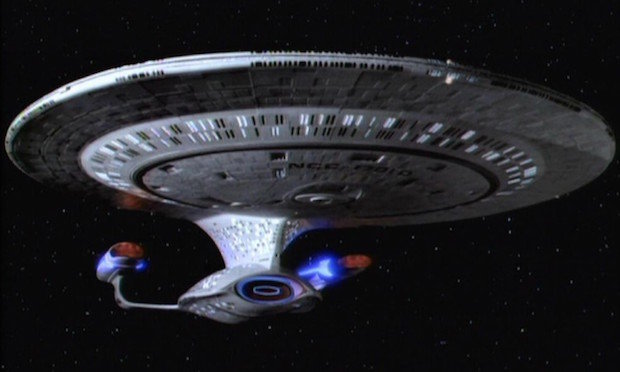
Fan-service (also seen as fanservice and fan service) involves giving fans what they want. Fan-service comes in a few different types. Long pans of cars, mecha, or environments are considered fan-service within science fiction genres. Think about the pans of the starship Enterprise found in Star Trek. Most of the time, fan-service brings to mind sexual, objectifying views of anime girls. This includes breast groping, upskirt views, panty views of all types, swimsuits, accidental nudity, and similar scenes. Female-oriented fan-service exists too. This type objectifies men in similar ways, but for the sake of this article, I’m going to focus on male-oriented fan-service–its is the most common type, after all.
I’ve used to word objectify a few times. Objectification happens when we look upon something and reduce them to objects instead of seeing them as a person. Objectification involves visually possessing a person by violating their boundaries. Looking up an anime character’s skirt to see her panty’s design is a classic example. While the underwear design suggests her true personality, as opposed to her public face, this is a violation of her privacy and reduces her to an erogenous zone. Some of this comes from the Japanese custom of honne and tatemae, the division between how a person really is and how that person behaves in public.
Japanese culture has a different view of nudity than the West does, and this view confuses Westerners. We think the Japanese are either free wheeling or indifferent to nudity. Some of these impressions come from the idea of mixed bathing as a norm with a dividing wall minimally separating the genders. The small towel used for privacy and the custom of just not looking doesn’t seem to help much from the Western view. Nudity was commonplace in pre-World War II Japan. Some remote villages had adults go naked through much of the year. Women worse small skirts or aprons, depending on their age. People would work nude or partially nude in fields during Japan’s feudal period (Downs, 1990). All of this contributed to Western attitudes toward Japanese nudity.
Fan-service ties with early Japanese photography. In the 1850s, the port city of Yokohama was the export capitol for photography, and women were the most common subject. More than half of Kimbei’s catalogue–one of the most influential photographers of the period–featured women. Only 70 photographs depicted men as the main subject. This fascination with women in imagery goes back further to the woodblock prints of the Edo period. Some of these depictions involved incidental nudity and peeks we would call fan-service today.
Types of Nudity in Anime

However, not all nudity is equal. In Japan, nudity has symbolic purposes. As any anime watcher knows, nudity associates with humor–especially for bathing scenes. Surprisingly, nudity lacks a major role in Japanese art, unlike Western art. When nudity appears, it’s in action: bathing, dressing, working, and having sex. The nudity itself was incidental to the action the artist wanted to show (Downs, 1990). Anime continues this tradition. Many fan-service scenes show glimpses as an incidental result of an action.
Nudity has three main purposes:
- Humor
- Sentimentality
- Sexual arousal
Fan-service revolves around the first and last types of nudity. It seems odd the say nudity can invoke feeling of sentimentality, but Japanese culture often uses nudity to make you feel sentimental toward family and motherhood (Downs, 1990). Nude humor appears throughout Japanese media and relates to someone being surprised while naked or with men/boys trying to see a nude woman when she think she has privacy. Downs (1990) writes: “Occasional scenes of high school girls peeking at male students do occur, particularly in manga and television comedies.” However, the nudity doesn’t make these scenes funny. Rather, the embarrassment does:
The Peeping Tom episodes common in cartoons, manga, television drama, and comedies suggest strongly that the Japanese do reserve to themselves a degree of personal privacy and that attempts to invade that privacy are often consider humorous, inasmuch as a nude person in the presence of a clothed person is at a social disadvantage.
Bare-chested women were common in prime-time Japanese television in 2001, but they weren’t treated as significant (Morikawa, 2001). Of course, nudity and eroticism link. Surprisingly, American media has more instances of explicit sexuality than Japanese culture despite nudity appearing more often in Japan. Japanese law prohibits explicit sexuality and full-frontal nudity of adults. Although this is hard to pin down because of the availability of pornography online.
Fan-service and Pornography
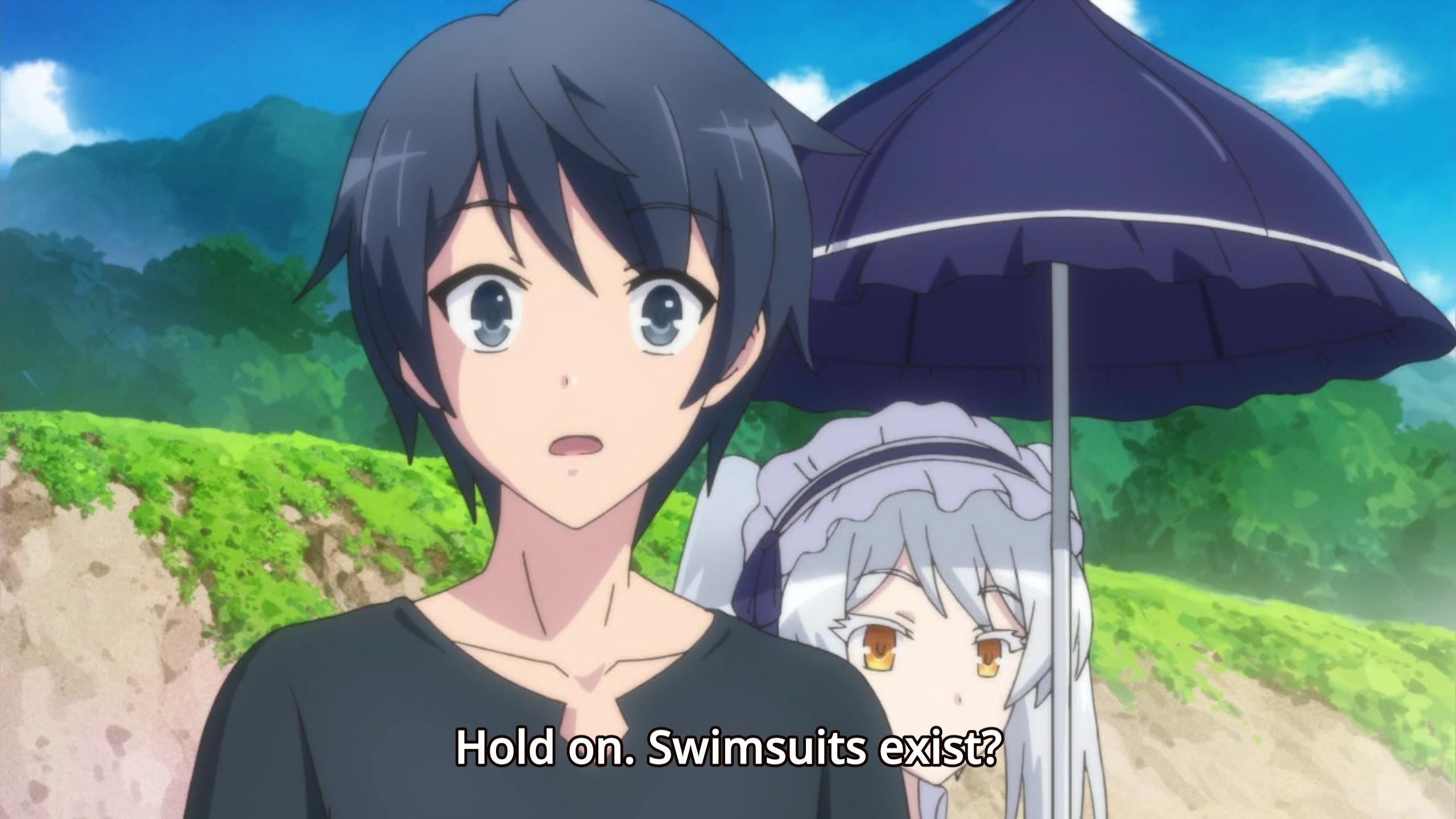 Pornography divides into two families: softcore and hardcore. Hardcore is what we typically think as pornography–explicit scenes of sex. Softcore is voyeuristic views of nudity and lacks explicit sex. Fan-service falls into the softcore category of pornography. In academic debates, pornography lacks a distinct definition. Some consider hardcore as porn and softcore as something else. Others consider video as pornography but not images. Recently, some researchers have defined pornography as “written, pictorial, or audio-visual representations depicting nudity or sexual behavior (Campbell, 2017).” This definition includes sexually-oriented romances and fan-fiction and fan-service. But this broad definition also includes paintings from the Renaissance.
I could find few studies on the affects of anime fan-service on viewers, but pornography is well studied. There are limits to how far we can take this. Anime fan-services are animated, fictional characters and this may not affect people as live-action depictions can. However, fan-service and porn share key elements that allow us to draw comparisons.
According to Gail Dines, a professor of sociology and women’s studies at Wheelock College in Boston: “Pornography is founded on human debasement, dehumanization, and cruelty.” In fact, male dominance is taken for granted in porn and sex (Lyford, 2017). Fan-service extends from a male dominant view and dehumanization. Now, I know many of you would disagree with this. Just consider how looking up an anime girl’s skirt is a violation of privacy and is taken for granted. Yes, the anime girl is fictional, but the method of thinking remains identical. Stories put anime girls into compromising positions and situations to show their assets off to primarily male gazes–an example of male dominance.
In porn, 88% of scenes include physical aggression toward women (Brosi, 2011). We don’t see physical aggression toward women–usually–in mainstream anime, but we do see standard breast groping scenes and other acts of unwanted physical contact. Both feature a male-dominance fantasy and mix unwanted attention with sexuality. Anime may do it to be funny, as we’ve seen, but again–and I know I flog the point–the humor comes at the expense of a female’s body autonomy.
Fan-service mainly focuses on straight males, just like porn does. Male porn use lowers female self-esteem, relationship quality, and sexual satisfaction (Newstrom, 2016). While this is speculation, I can see heavy fan-service consumption–ecchii, for example–having similar effects on a relationship.
Fan-service and the Perception of Anime and its Fans

Anime’s focus on fan-service creates a stigma around the genre. In an interview, a hentai animation director states (Mazurkewich, 2000):
Customers who buy [hentai] are afraid of real women so they tend to be interested in cartoon characters. I sometimes feel scared with the increasing number of people who are unable to communicate with each other.
The director paints with a broad brush. Not all hentai fans or fans with waifus are afraid of women; however, this idea that male anime fans who consume fan-service are afraid of women remains stubborn in many areas. And sometimes it is true.
Anime is a rich, wide genre filled with creative stories. However, fan-service blights mainstream perceptions of the medium. Rightly so in many ways. No matter how it’s examined, fan-service violates female privacy and her body autonomy. It takes a fictional character and places her private areas up for thousands to ogle. Yes, it is a drawing, but the mentality behind the ogling remains the problem. Companies make what sells. Fan-service reveals a troubling desire for many male fans to take their own pleasure at a female’s expense. Consider this against her willingly showing offer her assets to a character she likes (and no camera angles to make the audience into a voyeur). In this scenario, she retains her ability to choose who sees her body and who doesn’t–the interest but not the audience.
Other Issues with Fan-service
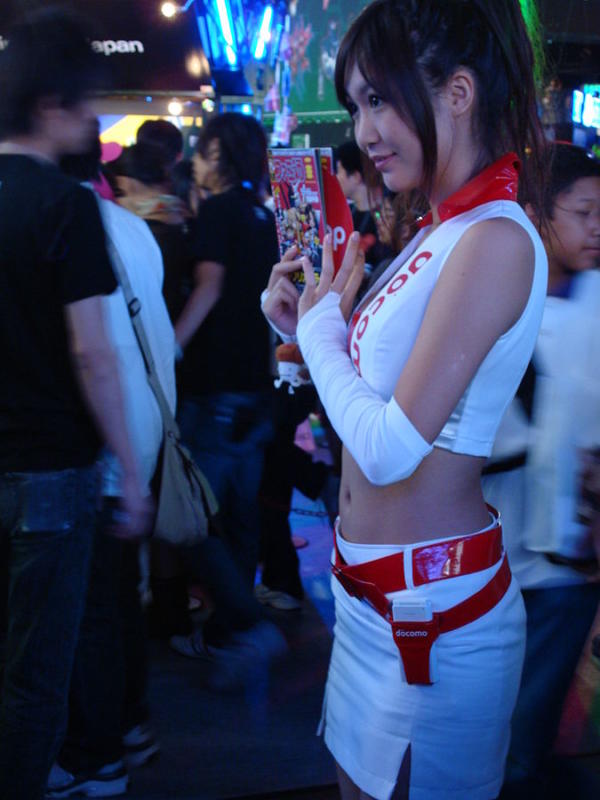
Fan-service distracts from the story. It brakes the story at awkward times, and often appears at inappropriate times in the plot, such as high action or dramatic scenes. Fan-service also targets strong female characters; it seeks to make these characters more palatable by still subjecting them to the male-dominate gaze. She may be making a crucial point for the story when a wind comes in and kicks up her skirt. Some of the timing comes from the embarrassment factor of fan-service. It happens when least expected because the character’s embarrassment makes the situation funny, but for those of us in the West, the timing disrupts the story. We also don’t have the same type of embarrassment-humor.
Anime has a habit of contriving the story to service fan-service, such as the obligatory beach scene. I’ve seen anime that bends the story just so it can show off its girls in bikinis. While bikini-clad girls are fine in this setting (it’s one of the few settings where fan-service isn’t obtrusive), how they get to the beach–such as the random school trip–hurts the story. It’s rare for fan-service to not disrupt the storytelling and jar the audience out of the spell. You see, fan-service by its nature pulls the audience out of the story. It’s designed to arouse the viewer, which makes the viewer aware of their body once again. It breaks immersion–the goal of good storytelling. The best stories make us forget ourselves until the end credits. Breaking story immersion is, perhaps, the greatest sin of fan-service. Anime fan-service defeats the entire point of weaving a story, particularly with its frequency.
Fan-service and the Otaku Community
Yes, I know some of you like fan-service. Fan-service is a big part of the otaku community. There are blogs dedicated to waifus and fan-service artwork. We should consider what this means for the community. On one hand, the artwork is similar to Western classical art, yet it also often shows the influence of pornography in the poses and situations. Modern nude art of all stripes show the hand of porn in the same way. When porn websites have grown from 900 in 1997 to over 2.5 million in 2012, we should expect porn to effect art (Newstrom, 2016).
As I’ve pointed out pornography has negative effects–it increases infidelity and lowers commitment; it fosters false beliefs about rape and increases rape acceptance (Brosi, 2011; Newstrom, 2016). Fan-service may share some of these negative effects too. Although waifuism does counter some of these issues.
Okay, I know I’ve droned on for a while. The long and short of it: fan-service hurts anime when it appears outside of ecchi and related genres. It fosters a male-dominate view that comes at the expense of women’s body autonomy, and it hurts storytelling. Of course, my Western perspective colors my view. Japanese culture’s view of nudity, particularly in terms of social embarrassment as the focus of humor, doesn’t resonate with me. Leaving this cultural flavor in small (small, being operative) doses will help keep anime’s flavor. But this can be done in ways that do not hurt the immersion of the viewer. Fan-service works fine when it exists within a story and doesn’t pull the viewer of out the story, but when the story has to conform to fan-service, the anime suffers.
References
Brosi, M. W.. Foubert, J.D.. Bannon, R.S. & Yandell, G (2011) Effects of Sorority Members’ Pornography Use on Bystander Intervention in a Sexual Assualt Situation and Rape Myth Acceptance. The Research Journal of the Association of Fraternity/Sorority Advistors, 6(2). 26-35.
Campbell, L. & Taylor Kohut (2017) The use and effects of pornography in romantic relationships. Current Opinion in Psychology 13. 6-10.
Lyford, C. (2016). Clinician’s Digest. Psychotherapy Networker Magazine, 40(4), 11-12.
Mazurkewich, Karen (2000). The Dark Side of Animation. Far Eastern Economic Review. 163 (32). 56-57.
Morikawa, K. (2001). Television in Japan: no longer reflects cultural heritage but still remains quintessentially Japanese. Television Quarterly, (1), 24.
Newstrom, N. & Steven Harris (2016). Pornograpy and Couples: What Does the Research Tell Us? Contemp Fam Ther. 38. 412-423.
Wakita, Mio (2009). Selling Japan: Kusakabe Kimbei’s Image of Japanese Women. History of Photography. 33 (2) 209-223.


Leave a Reply